The Iberian organ repertoire is some of the most overlooked in all of organ music. This could be for a variety of reasons, including the relatively traditional structures of the pieces as well as the incompatibility of the modern organ to play this music well. However, the few people who are familiar with this music know that it is some of the most beautiful and diverse music ever written for the pipe organ. The Iberian organ itself is just as interesting; its groundbreaking advancements in organbuilding can even be considered as significant as the advancements made by the French in the 19th century.
Development
Before the 15th and 16th centuries, Iberian organs, like the organs in the rest of Europe, were based on a single blockwerk. Throughout the 16th century however, this system was phased out in favor of individual registers. Iberian organs took on their own character with the division of registers and the inclusion of many en chamade reeds. The Iberian organ began its development in Catalonia, although these instruments were relatively large compared to organs from other regions in the Iberian peninsula. Castilian organs in comparison were considerably smaller. Organs from Galicia were generally of a similar composition and size as their Castilian counterparts.
Structure
Typically, Iberian organs consisted of a single manual, but in exceptional cases two or even three manual instruments were made. A notable feature in larger Iberian organs was the Cadereta interior or Arca de ecos. These divisions were usually placed in a closed off or distant part of the organ to create an echo effect. The arca de ecos specifically was only allocated half of a manual since its purpose was not to play full passages, but instead to create a dynamic contrast for call and response sections of music. Some organs used a knee or foot lever to open or close the arca de ecos. Occasionally, knee or foot levers existed which were used to draw the reeds of the organ, allowing for a quick change in registration in a time when the stiff mechanical action of the drawknobs posed a major limitation to the organist without assistance from stop-pullers. The split manual is without a doubt one of the most distinctive aspects of the Iberian organ. The stops are typically split between middle C and C sharp, which permits a stop to only sound for the upper or lower half of the keyboard. This allowed for melody and accompaniment to be played on a single manual, which saved both cost and space. For this reason, the top and bottom halves of the registers were called the tiples and bajos, respectively.
The list below provides examples of manuals usually present in Iberian organs, as well as a modernized description of each manual to aid in understanding.
- Organo mayor (Great organ)
- Cadereta (Swell)
- Cadereta interior (Swell division, boxed off)
- Arca de ecos (Echo division)
Mark J. Merrill, a writer on The Diapason, claims that the octaves of the keyboard also had their own names, similar to the names used for vocal ranges. These are listed below.
- Grave (Lowermost octave)
- Baja (Octave below middle C)
- Media (Octave beginning on middle C)
- Aguda (One octave above middle C)
- Sobreaguda (Two octaves below middle C. This octave is not present on many Iberian organs since much of the repertoire does not call for its use.)
In larger instruments, a third manual, sometimes called the Órgano de la Espalda, sounds into the church from the reverse side of the case.
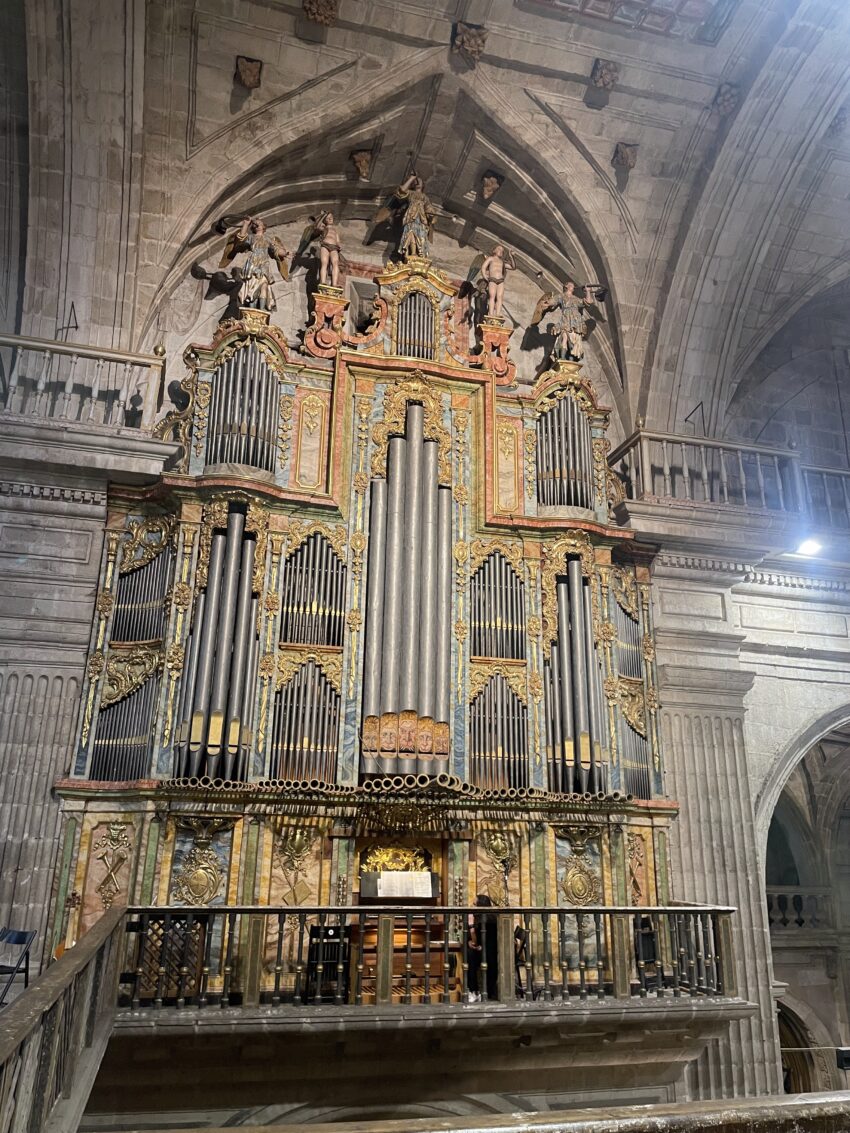
The appearance of the Iberian organ is often very ornate, complete with paintings and copious amounts of gold leaf. Much of the attention is drawn to the chamade reeds, whose commanding presence dominates the exterior of the organ.
Pedals were rarely present in Iberian organs. When they were, they usually consisted of round wooden buttons which sounded a single 16’ stop.
Registers
All registers are measured in palmos, which is roughly a hand width. The term caños was usually used in historical organbuilding, but many modern builders use the term tubos instead. Flue pipes are divided into two separate categories, the flautados and the nasardos. Flautados are very similar to what most would call the principal chorus, while nasardos consist of softer stops and mutations. These two categories are meant to form two separate choruses of pipes, called the coro estrecho and coro ancho, respectively. The reed stops are known as lenguas, and they are by far the most diverse registers of the Iberian organ. The length of the resonator plays a great role in determining the tone of these registers, so Iberian organbuilders have divided them into two categories. The first is called the cortos, which have a half or quarter length resonator. The second category, called the reales, is reserved for lenguas with full length resonators (for example, an 8 foot resonator for an 8 foot pitch stop.) Among the cortos category, the viejos and viejas stops are some of the most fascinating registers on the Iberian organ. Both are very nasal, and are not nearly as loud as the other reeds on the organ. The main distinction is that the viejas play on the lower half of the keyboard, while the viejos play on the upper half. All of the lenguas are divided into two categories based on their position on the organ. Horizontal/chamade reeds are called trompetas de batalla, while reeds placed on the inside of the case are trompetas interiores.
The following chart lists common lenguas on Iberian organs, separated between cortos and reales. Registers marked with * are usually horizontal. The pitches at which these registers most often appear are listed within the parenthesis.
Examples of lenguas cortos:
- Violeta* (2’ or 4’)
- Chirimía* (2’ or 4’)
- Chirimía alta* (4’)
- Clarinete* (4’ or 8’)
- Viejos* (8’)
- Orlos* (8’)
- Trompetas Bastardas* (8’)
- Dulzainas* (8’ or 16’)
- Viejas* (16’)
Examples of lenguas reales:
- Trompeta Real (8’)
- Bajoncillo* (4’)
- Clarin en 15º* (2’)
- Clarin Bajo* (8’)
- Trompeta de Batalla* (8’)
- Trompeta Magna* (16’)
- Trompeta Imperial* (32’)
The Repertoire
Iberian organ repertoire is primarily influenced by the choral style of composing used during the Renaissance period. Major forms include diferencias (variations on a theme), tientos (larger polyphonic works similar to fantasias), and versets (short pieces usually used for liturgical purposes). Batallas are arguably the most famous of these forms, since they make use of the horizontal reeds in order to depict a battle. Antonio de Cabezón and Sebastián Aguilera de Heredia were without a doubt the greatest Iberian composers of the 16th century. Their music is similar in style to the vocal motets written at the time. Later composers such as Joan Cabanilles and José Lidón took more liberties with their compositional styles. A particularly interesting form typical of the Iberian organ repertoire is the tiento de falsas, which is a larger scale work which uses many chromatic passing tones. The constant chromatic motion used in these pieces foreshadows some Romantic composers like Max Reger.
Sources Used
https://www.thediapason.com/content/early-iberian-organ-design-and-disposition
https://ifc.dpz.es/recursos/publicaciones/39/27/05perez.pdf
https://www.organartmedia.com/downloads/Historic_Spanish_organs.pdf
https://pipedreams.publicradio.org/tour/2013spain/2013pipedreams-posttrip.pdf