

In the vast world of Romantic piano repertoire, few composers are as mysterious and misunderstood as Alkan. He was a contemporary of Chopin and Liszt, but remained unknown even during his lifetime due to his reclusiveness. This resulted in the majority of his work being forgotten. Only in the last fifty years has his music begun to receive the attention it deserves. Despite his obscurity, Alkan was very prolific, and wrote some of the most technically demanding works in the piano repertoire. Among these works are the 12 Études dans tous les tons mineurs, Op 39. This monumental work includes a symphony and concerto for solo piano, which require the pianist to imitate the orchestra and contrast between the “soloist” and “full orchestra.” The twelfth étude in the set is titled Le Festin d’Ésope, which translates to “Aesop’s Feast.” This piece is a vivid depiction of a popular tale, which is communicated through the form of a theme with variations.
Who was Charles-Valentin Alkan?
Charles-Valentin Alkan was born in Paris in 1813, and showed his natural talent for music at a young age. At the age of six he began studying at the Paris Conservatoire, and quickly developed virtuosic abilities on the piano and organ. Later on, he developed friendships with other composer-pianists like Chopin and Liszt. For unknown reasons, he withdrew from society in 1853, and wouldn’t make another public appearance for over twenty years. During this period of isolation, he composed many of his most significant works, including his organ/pedal piano etudes, the Op. 61 Sonatina, and the Op. 39 collection of études.
Alkan’s style was very extreme in virtuosity and structure. He combined the dramatic and structured style of Beethoven with the virtuosity and chromaticism of Romantic music, which resulted in an interesting and difficult to understand style of writing. His harmonic language was rather old fashioned for his time, but he still made significant advancements in music, including some of the earliest uses of Jewish melodies in classical music.
The Story Behind the Étude
Among Alkan’s many compositions for piano, Le Festin d’Ésope stands out as one of his most humorous and imaginative works. It takes the form of a theme and variations. The theme is in the key of E minor, and is immediately followed by 25 variations, each with a distinct character.
The piece was inspired by an old story about the slave Aesop, remembered today for his many fables. In the story, Aesop’s master asks him to prepare a feast using the finest ingredients he can find. When the day of the feast arrived, Aesop presented many different dishes, but all of them were made from a single ingredient: tongue. When asked about the meal, Aesop explains that the tongue was the best of all things since it allowed for the creation of laws, truth, philosophy, and poetry. The people attending the feast then ask Aesop to prepare a second feast the following day, this time made with the worst ingredients. To their surprise, Aesop again serves only tongue, explaining that it was also responsible for lies, violence, and the ruin of friendships.
Alkan’s piece is clearly a musical rendition of this story: a single ingredient served in twenty-five different dishes. These variations reimagine the theme in many different ways, from calm meditations to exciting fanfares. Some have suggested that this work was also inspired from Aesop’s own fables, with each variation representing a fable. While there isn’t any writing from Alkan to support this interpretation, it should still be taken into consideration due to the wild and sometimes animalistic noises Alkan includes in this étude. The result is a magical study in transformation, a prime example of musical storytelling, and a feast for any pianist brave enough to take a seat at Alkan’s table.
Recordings
Alkan’s music has gotten much more attention in recent years, but recordings and performances are still rare. However, this piece is one of his most well-known works, and there are several excellent recordings that stand out to me.
Marc-André Hamelin
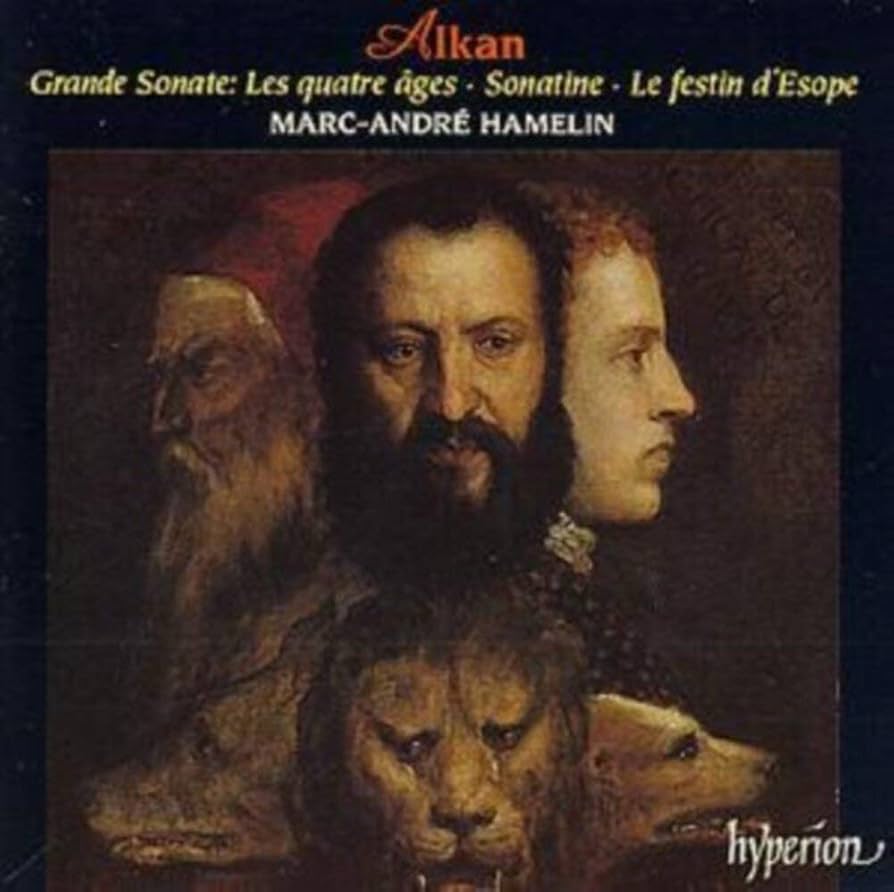
Marc-André Hamelin has recorded numerous works by Alkan, including the Concerto for Solo Piano and the great Quatre âges sonata. This album, released by Hyperion, features many of Alkan’s masterpieces, including Le Festin d’Esope. This recording is one of my favorites for its expressiveness and clarity. Each variation has its own mood and identity, while the whole work is unified by Hamelin’s superhuman technique and carefully conceived musical vision.
Jack Gibbons
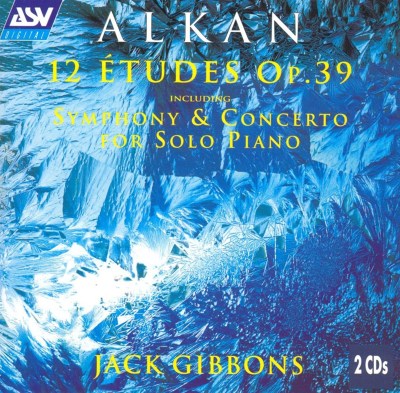
This excellent album features not only the twelve etudes, but also selections from Alkan’s Préludes and Esquiesses, which highlight the composer’s more lyrical side. Gibbons doesn’t reserve his musicality for the slower pieces, however-he brings out all the delicate details of the slower variations of Le Festin d’Esope, while still communicating the music’s ferocity during the most energetic variations.