
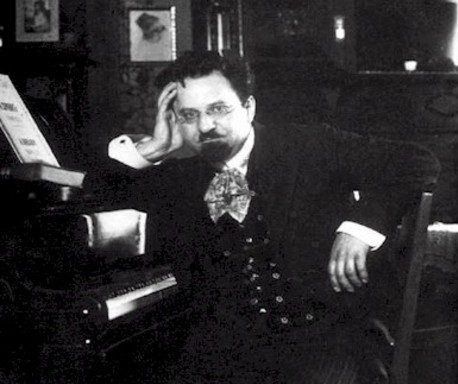
Sigfrid Karg-Elert (1877-1933) was a prolific German composer. From a young age he demonstrated great potential in music, and eventually studied at the Leipzig Conservatory. His greatest contributions to classical music were mainly works written for the pipe organ and harmonium. These pieces range from small chorale preludes or character pieces all the way to massive passacaglias and even a symphony written for solo organ. He is particularly interesting due to the period in which he lived. He was influenced by late romantic composers like Max Reger as well as other composers like Scriabin and Debussy. I consider him to be the first modernist composer because he combines late romantic styles with impressionistic harmonies and tonal ambiguity. This intricate style of writing wouldn’t be revisited until later composers like Hindemith and Alain. Additionally, Karg-Elert had a strong admiration for Johann Sebastian Bach, which is most evident in his compositions for organ. He took traditional baroque forms and expanded them through the use of his innovative harmonic palette and Reger-like polyphony. This resulted in large experimental works which broke the boundaries of composition while still paying respects to the traditions of the past.
About this Piece
In the year 1911, Karg-Elert published one of his largest works: a collection of three symphonic chorales for organ, all written on German chorale melodies. The second of these is based on the chorale “Jesu, meine Freude.” This monumental piece is divided into three movements, and a typical performance lasts for about 20 minutes.
The first movement is titled “Introduzione (Inferno)” and bears the tempo marking andantino agitato. It begins with an ascending line which is immediately imitated in the other voices, creating an intricate web of chromatic lines which all modulate freely. This section grows in complexity and harmonic tension until it is finally interrupted by rapid ascending scales and loud chords. Only after this section is the chorale melody first introduced using the softer registers of the organ. Material from the beginning of the work is reiterated, this time with a different character before the chorale is concluded. This section is suddenly interrupted by quick runs up and down the manuals using the full organ. This is followed by a toccata-like section with the pedals playing a line which resembles the chorale after which this piece is named. After a short quiet interlude, Karg-Elert concludes the movement by revisiting the toccata section and ending with a triumphant C major chord using every register on the organ.
The second movement is a quiet Canzone which consists of a melody and a polyphonic accompaniment. The melody is a highly ornamented version of the “Jesu, meine Freude” chorale. This movement slowly proceeds through the chorale before building up to a mezzo-forte dynamic, which directly transitions to the third and final movement of the work.
This third movement is a fugue. The subject is only vaguely related to the chorale melody, but has a jumpy rhythm that provides a contrast with the previous movement. After three voices have been introduced, the fugue briefly goes into a quieter section, before crescendoing into a fortissimo statement of the subject, accompanied by the pedal. This is followed by a quieter, manuals only section in which ornamented fragments of the chorale are imitated between the different voices. This section then builds up until finally the chorale melody is introduced without ornaments, alternating between the pedal and manuals. A brief run up the keyboard reminiscent of the first movement leads to the finale of the work, a highly chromatic harmonization of the “Jesu, mine Freude” chorale.
Conclusion
Karg-Elert’s symphonic chorale on “Jesu, meine Freude” for organ stands as a work of incredible depth and complexity. His use of complex structures and harmonies exemplify this twenty-minute-long work as a major milestone in organ music. Each section of the work shows the composer’s ability to transform the chorale and give it a new feeling every time it reappears. Overall, this work showcases Karg-Elert’s mastery over large forms, and serves as a compelling case for his place in today’s organ repertoire.