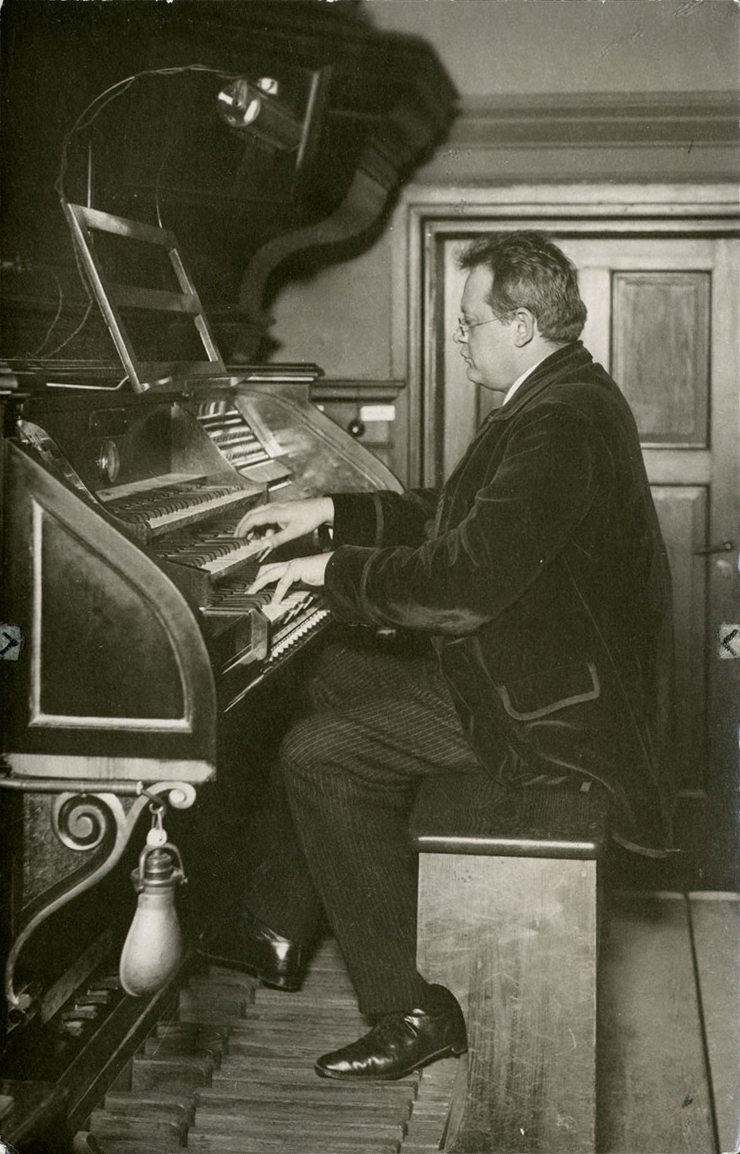
Late romantic composer Max Reger was admired by composers like Schoenberg, and was one of the greatest composers of the German organ tradition. His music has always been very controversial. Paul Rosenfeld reviewed Reger’s music, writing, “His works … are like mathematical problems and solutions, sheer brain-spun and unlyrical.” He even went on to call Reger a musical “promise unfullfilled.” Irving Kolodin described one of Reger’s string quartets, writing that it “looks like music, it sounds like music, it might even taste like music; yet it remains, stubbornly, not music.”
Despite all the criticism Reger recieved during his lifetime, he worked tirelessly performing and composing. He composed over 800 pieces in his life which was cut short at 43 due to a heart attack. These works include over 100 pieces written for the organ, usually using baroque forms. Although he was a master of counterpoint and forms like fugue and canon, he also used very modern harmonies in his music. His writing constantly modulated, a tonal labyrinth which make it challenging to figure out which key you are in at any given moment.
During his lifetime, he was always considered either too avant-garde or too old-fashoned. Many of his pieces, especially for organ, are extremely modern and hard to understand. My goal in writing this article is to give classical music enthusiasts some stepping stones into the world of Reger. These pieces showcase Reger’s contrapunctal and harmonic genius without being as dense and unwelcoming as his greatest masterpieces.
30 Little Chorale Preludes, Op. 135a
This set of chorale preludes published in 1915, are really more like chorale harmonizations. Even though they are simple, these pieces still demonstrate Reger’s musical language and skill at writing for the organ. Something to listen for is Reger’s frequent use of chromatic passing tones and dynamic changes.
Variations and Fugue on a Theme of Telemann, Op. 134
Many of Reger’s pieces consist of variations, which are altered versions of a theme. Reger demonstrates his inventiveness by taking a small theme by Telemann and writing 23 variations on it before concluding the piece with an incredible four voice fugue.
Seven Pieces, Op. 145
These organ works all incorporate chorales, Christmas carols, or other popular melodies from the time. Some notable selections from this set include No. 2, Dankpsalm, which ends with a chromatic harmonization of the chorale Lobe den Herrn, and No. 7, Siegesfeier, which uses both the chorale Nun danket alle Gott and the German national anthem (which was only adopted several years after Reger’s death.)
Aus der Jugendzeit, Op. 17
This small collection of twenty character pieces written for the piano are very beautiful and not contrapunctally dense like Reger’s other works. My favorite is number fourteen, titled “Kleiner Trotzkopf.”
Conclusion
Reger’s music is often criticized for its lack of melody and complex harmonic changes. While both of these make much of his music rather inaccessible to new listeners, these pieces are some of the greatest entry points into Reger’s body of work.