
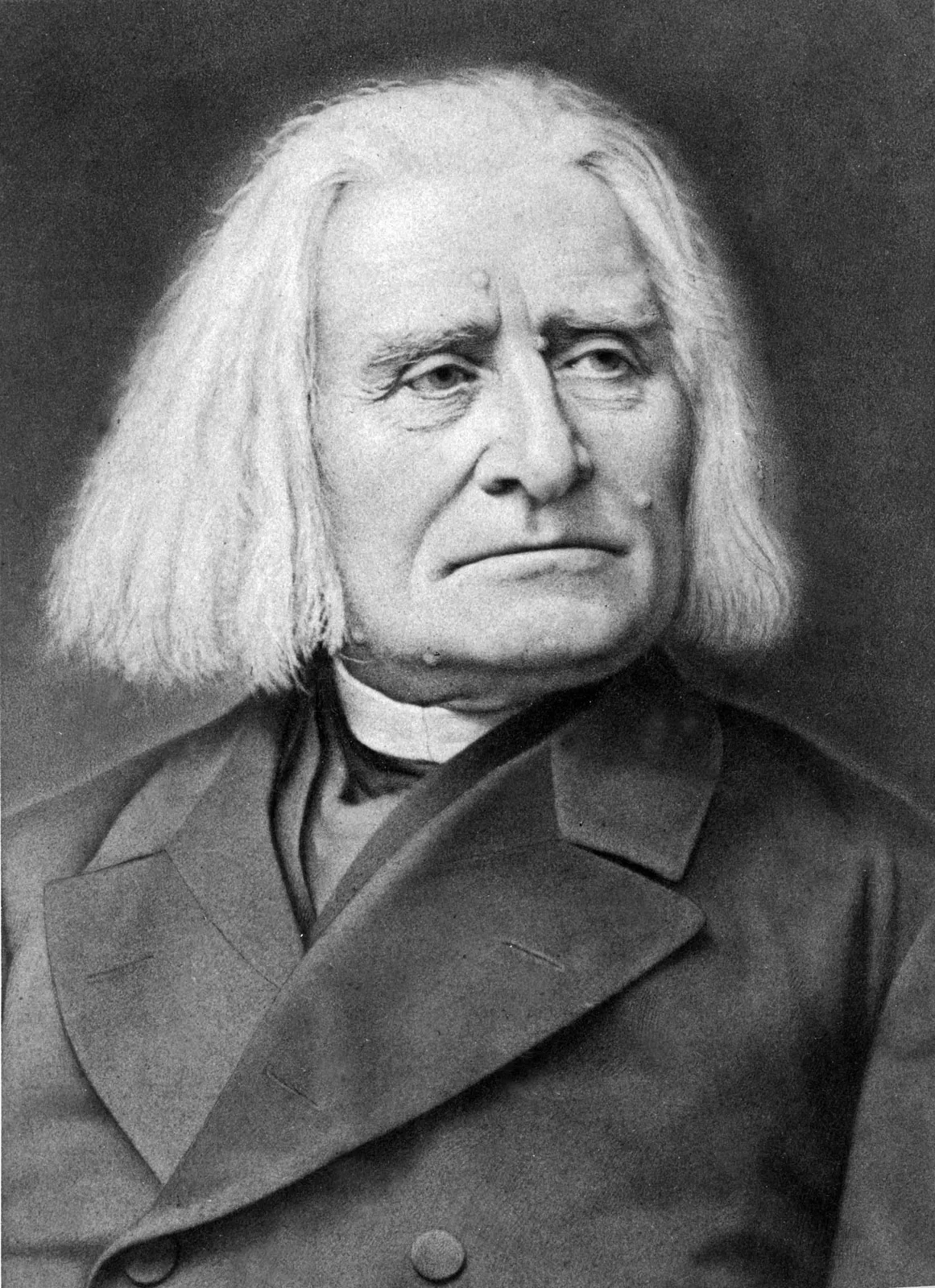
Franz Liszt is a name that strikes fear in the hearts of pianists. His incredibly difficult and virtuosic works for piano are major milestones in piano repertoire, even when compared to some contemporary pieces of music.
Hungarian composer Franz Liszt was born in 1811. He was one of the major composers of the Romantic period, and is known for his incorporation of Hungarian and Gypsy music in his compositions. During the first half of his lifetime, he toured extensively as a piano performer, sparking an incredible frenzy which can only be compared to the popularity of the Beatles during the 60’s. After retiring from his performing, he moved to Weimar and then Rome, focusing much of his time on teaching and composing. His music until this point is characterized by fast, dense passages and complex forms. However, in the last couple years of his life, his style underwent a great change, and he began to use very chromatic, dissonant harmonies. This was all written using a very empty and bare texture, which can even be considered a precursor to minimalism. Unfortunately, these pieces are rarely performed and recieve little attention, despite their high quality.
Characteristics of Liszt’s Late Years
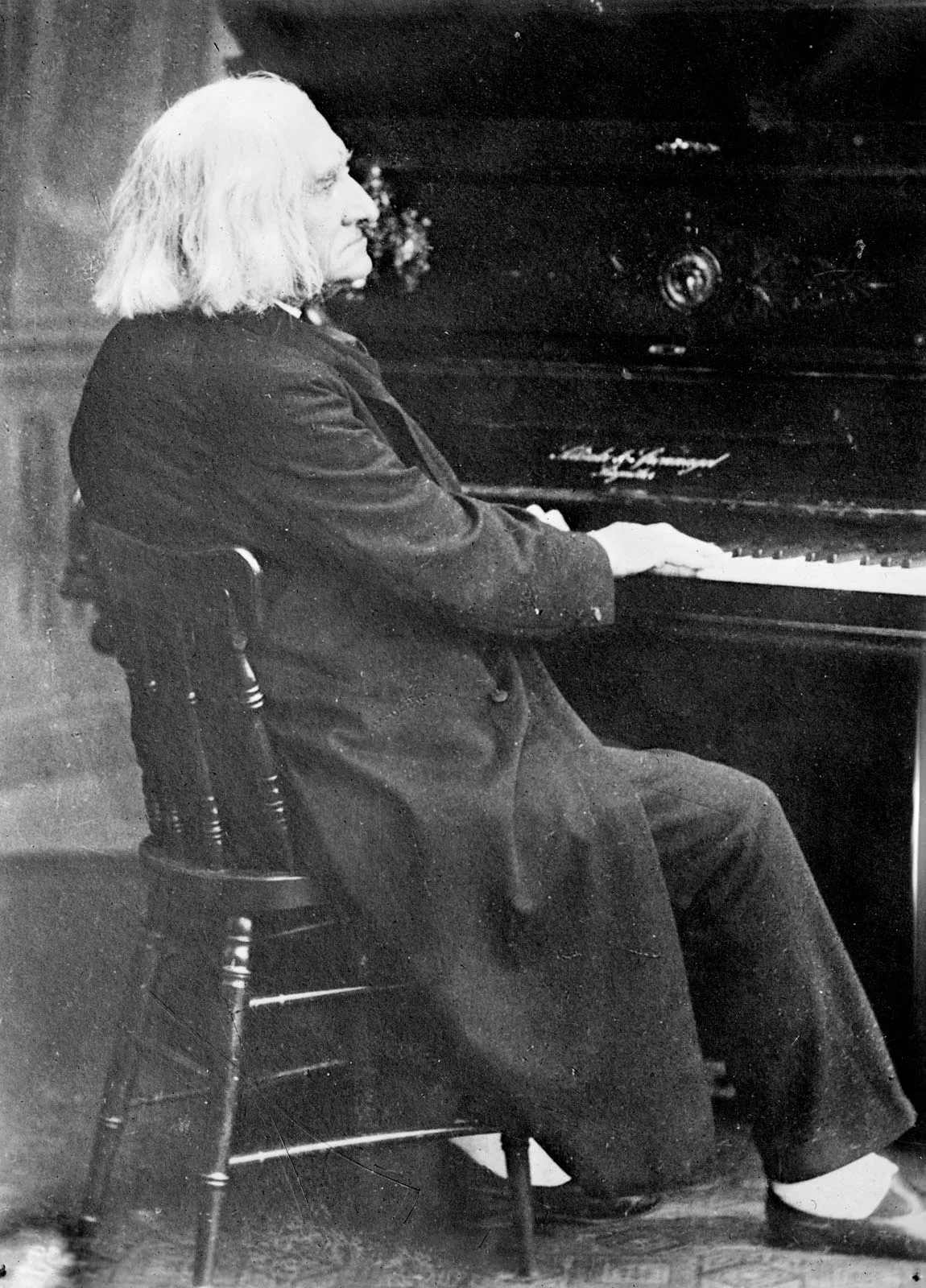
Works from this period are very minimalistic. Some even consist simply of a melody with sparse chordal accompaniment. In addition, Liszt uses very chromatic harmonies, similar to those used in some of Wagner’s music. Many of these late works push the bounds of tonality, having seemingly no tonal center at all. Liszt makes frequent use of non-functional harmonies, augmented and diminished chords, and chromatic melodies that lack a clear direction. During this time, Liszt’s health was deteriorating with age, and so many works from this time were influenced by religion and his preoccupation with death. These works paved the way for composers like Reger and Bartók.
Notable Works from this Period
Mephisto Waltzes 2-4
These three pieces, S.515, S216, and S216b respectively, all draw some degree of inspiration from Lenau’s Faust. The second is notable for ending in a tritone, which is an interval strongly associated with the devil. The third has a very beautiful and mysterious theme, opening with several broken chords before leading into the main “waltz” section. The fourth Mephisto Waltz (S.216a) was never finished. It begins and ends with lively sections, but the slow, lyrical, middle section was not completed. The fourth is my personal favorite due to its mystical harmonies and the strange atmosphere that it creates.
Bagatelle sans tonalité, S.216b
The manuscript of this little piece has the subtitle “Fourth Mephisto Waltz,” indicating that it may have been an alternate version or replacement for the Mephisto Waltz S.216a. This piece lacks a clear tonal center, anticipating later composers like Schoenberg and Webern. Liszt even uses a fragment of the octotonic scale in this composition, which would later become a staple of Messiaen’s music.
Mephisto Polka, S.217
This small piece of program music is also based on Lenau’s Faust. Liszt dedicated this piece to his student Lina Schmalhausen, who tended to Liszt in his old age. It uses much less chromaticism than the other “Mephisto” works, but is still mysterious and disturbing. The flow of the piece stops suddenly towards the end, and then finishes with a single F-natural, the leading tone of the key F-sharp minor.
Unstern! – Sinistre – Disastro, S.208
This piece uses many tritones and augmented chords. It begins with a mysterious introduction before leading into a march-like section. This section consists of a repeated note following a dotted rhythm in the right hand, while the left hand plays a very unfriendly melody. The piece alternates between these ideas before ending with a quiet section which Liszt calls “quasi organo.” I consider this piece to be one of Liszt’s finest works.
Conclusion
While they may not be as elaborate as Liszt’s greatest works like the Trancendental Etudes or B minor sonata, I believe that the late Liszt pieces are works of incredible depth and historical importance. I have recently focused on studying these pieces more and incorporating some harmonies into my own improvisations and compositions. I hope that any performers reading this will seriously consider looking into these pieces and giving them a place in future recitals.